Cyprus: a dice-crafting territory game you can play in the browser
A nine-turn game for 2–6 people where you fight over a hex map with dice you build yourself. It started as a phone app for game night; now it runs anywhere with a browser. Early playtest build, rules still moving.
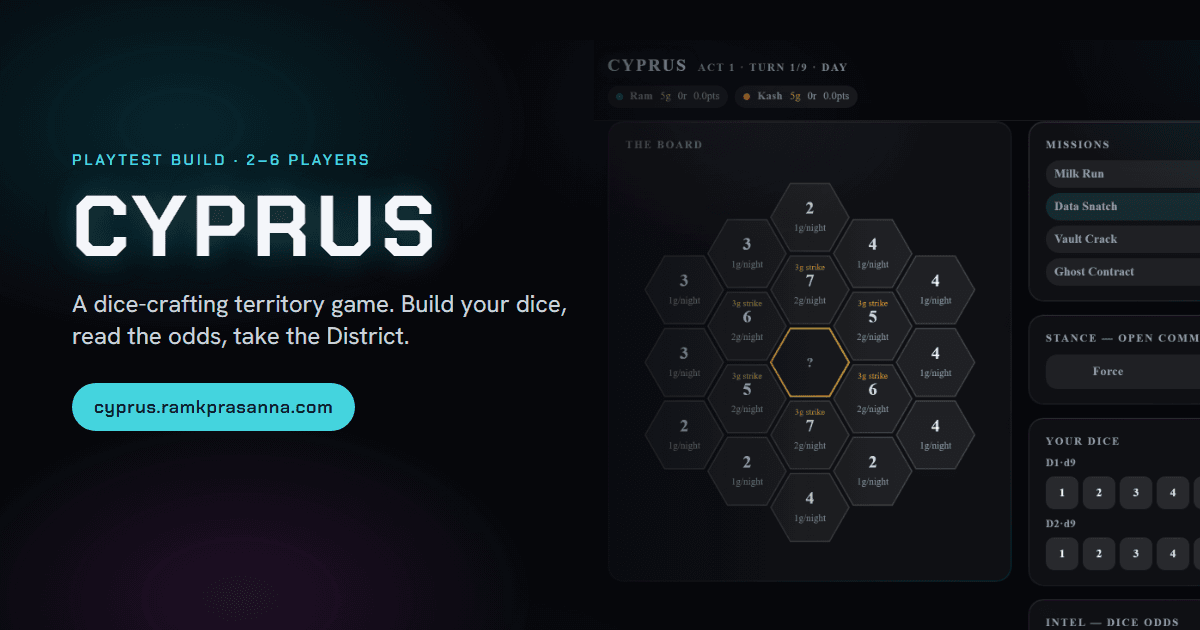
Play it at cyprus.ramkprasanna.com. 2–6 players, each on their own phone or laptop; sign in with Google or take a guest seat, share the five-letter code, and go. It is an early playtest build. Expect the rules to change between visits.
The idea
Most dice games hand you the dice. In Cyprus you build them. Everyone starts with a small kit, say three five-sided dice, and over nine turns you grow them at a nightly workbench: add a face, bump a value, double a face, duplicate the good ones, attach a perk that pays gold or reputation whenever that face comes up. By the end, your pool looks nothing like anyone else's, and watching your own die roll a doubled 6 with a gold perk on it is the whole point.
The dice are how you fight over the board. Each turn has a day and a night:
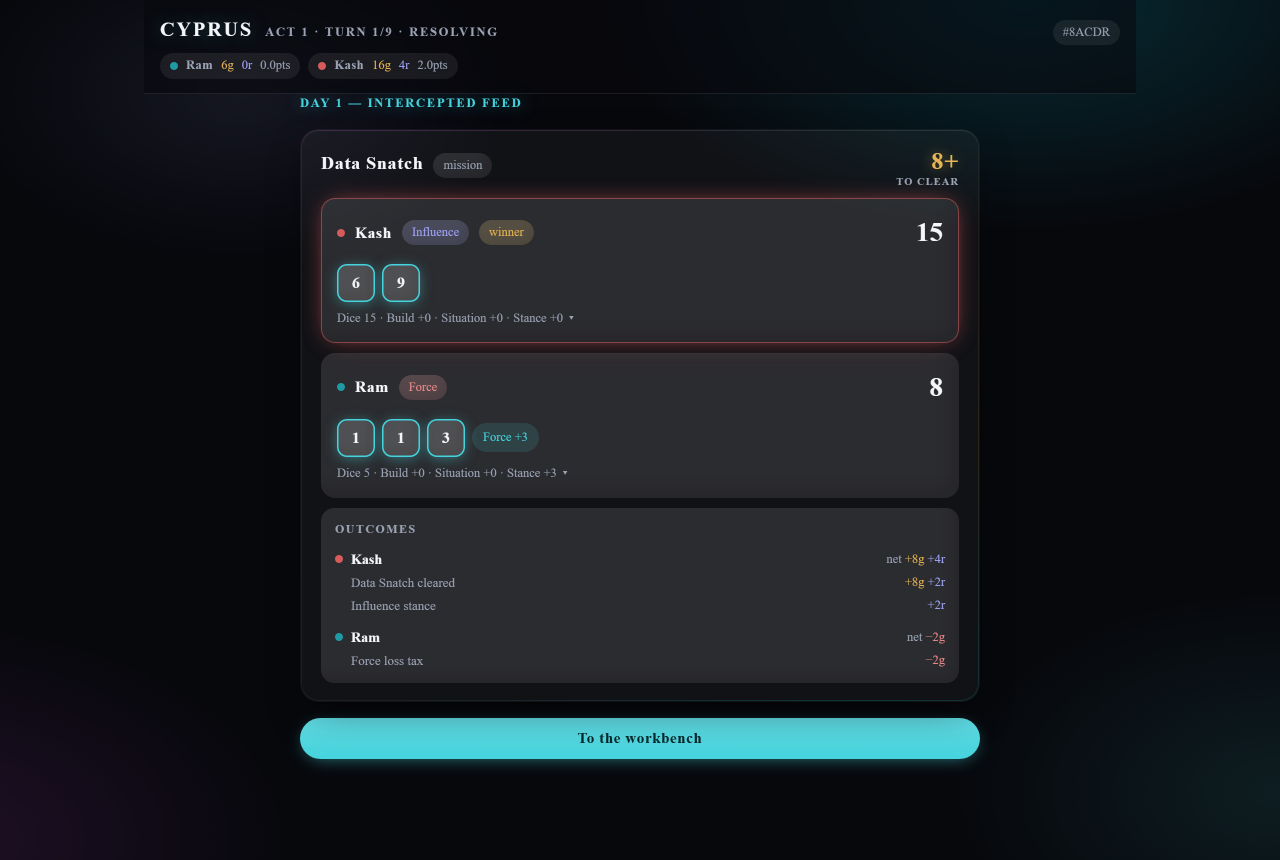
- Day. Everyone secretly picks a target, either a mission (roll over a fixed number for gold and reputation) or a hex on the map (roll higher than whoever holds it), plus a stance. Then all the dice roll at once and the results play out in an intercepted feed, one encounter at a time.
- Night. Everyone opens the workbench, spends what they earned, and reshapes their dice for tomorrow.
After the ninth turn, the influence of the hexes you hold plus half your reputation is your score.
Reading the table
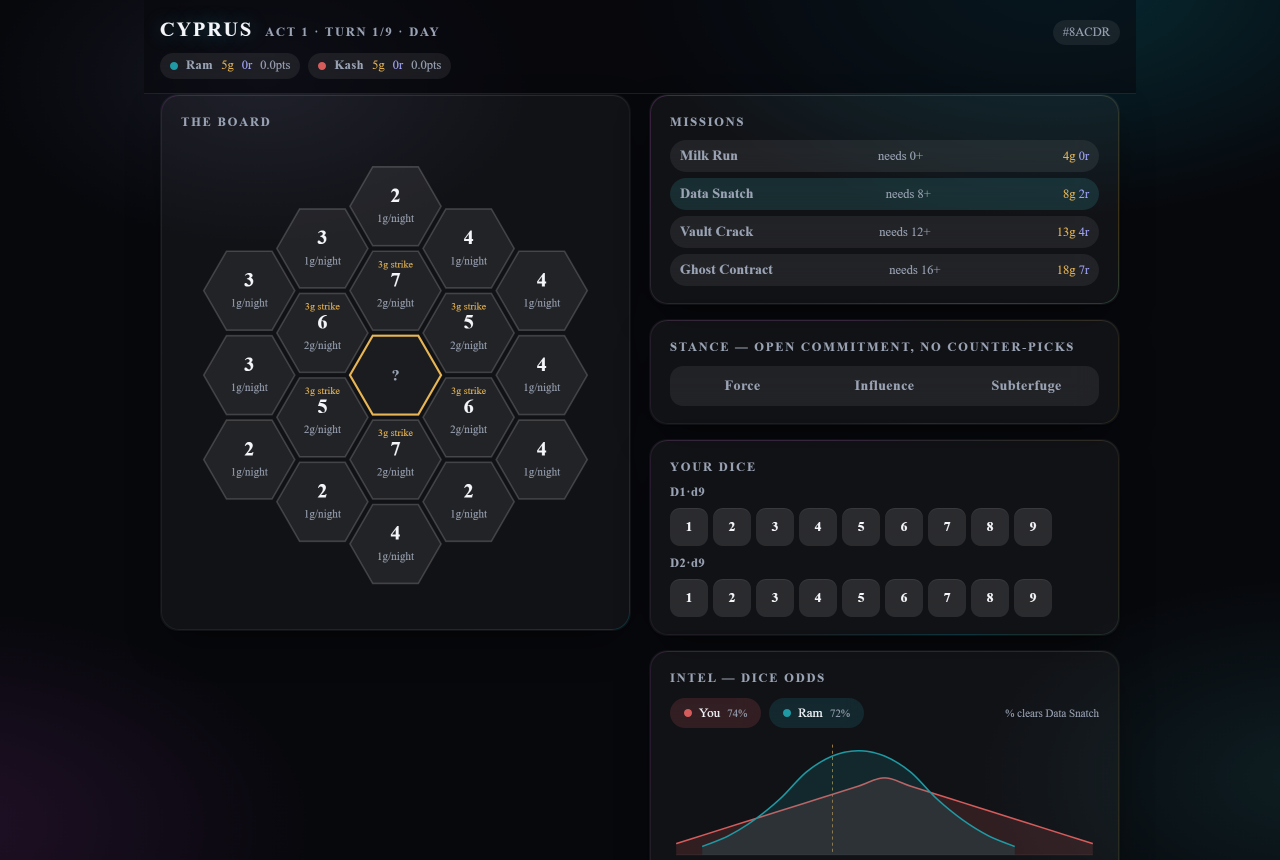
Every player's dice are public, so the interesting decision is not what you rolled but what you knew before rolling. The Intel card computes the exact distribution of each player's dice total (the true distribution, not a simulation), overlays them, and gives head-to-head odds: pick a mission and it shows how likely each of you is to clear it; pick someone's hex and it shows your odds of out-rolling them. Ties keep the hex with the defender, so a 50/50 is not a coin flip.
Stances are the other open decision. Force adds to your roll but costs gold when you lose. Influence earns reputation whether you win or lose. Subterfuge skims gold from whoever beats you. Nobody counters anyone in secret; you read the table and commit.
Where it came from
The first version was a phone app I built to play with friends, with a rock-paper-scissors layer between three approaches, a night phase that sprawled across half a dozen shops, and a catalog of about ninety items. It was fun to build and hard to teach. Moving it to the browser was a chance to cut: stances replaced the hidden counter-picks, the night became one screen, the item list shrank to thirty with a line of rules text each, the match shortened to nine turns in three acts, and the hexes became a real map with adjacency, so where you expand matters.
The engine is deterministic: every roll is seeded from the game, the turn, and the target, so every player's device computes the same result and a match can be replayed exactly. That is also what makes the intel chart honest; the odds it shows are the odds the engine uses.
What it is not, yet
It is not balanced and it is not finished. After a few real sessions the honest summary is that the pieces work and the game underneath them does not feel good enough yet, so the next pass is a design pass, not a polish pass. If you play a round and something felt pointless, that is the most useful thing you can tell me: ramkprasanna@gmail.com.
Play: cyprus.ramkprasanna.com. Questions and a short how-to are on the support page.