Stair-step or L? Crossing with the light on the Manhattan grid
Hypothesis: on the grid, crossing the avenue when the light allows and turning uptown when it doesn't beats the plain L. A simulator with NYC signal timing says yes, by about 50 seconds on a 13-minute walk, if you are patient at the corner.
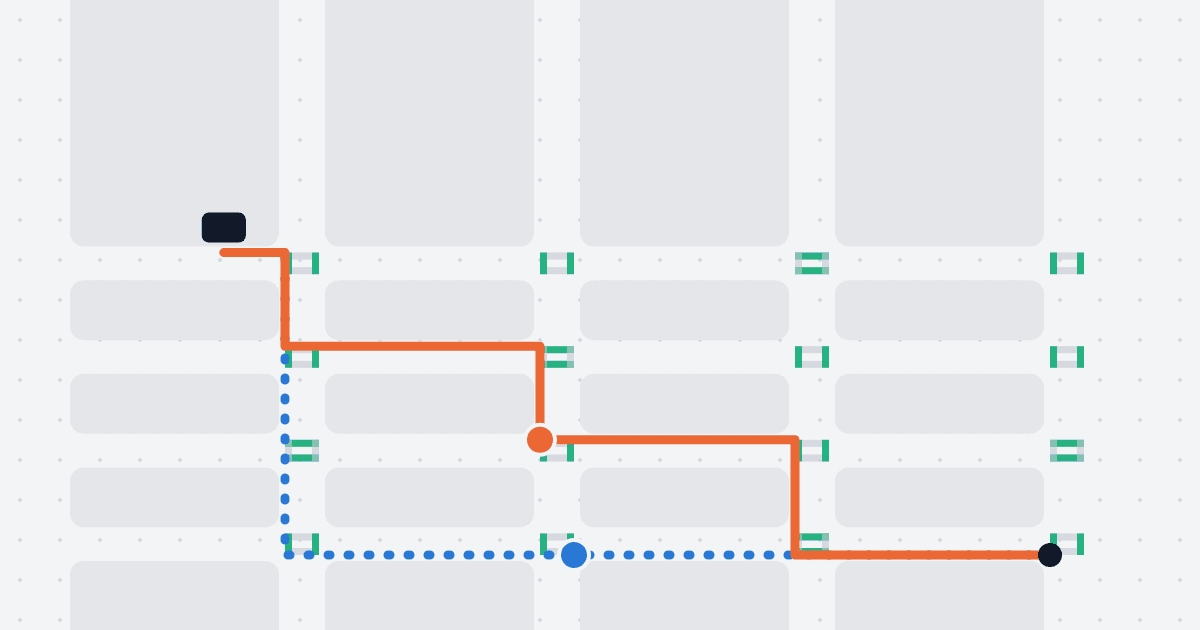
Hypothesis: on the Manhattan grid, a stair-step (cross the avenue when the light lets you, otherwise turn uptown) beats the plain L. Result: it does, by about 50 seconds on my 13-minute walk, on roughly four mornings in five, and only if you are patient at the corner. The simulator below runs 10,000 mornings per setting; the walk, the timing and the rule are all adjustable.
Hypothesis
Every west-and-north route across the grid is the same length. The L and the stair-step differ only in time spent standing at corners. The two kinds of corner are not alike: an avenue is 100 feet wide and you cross it when the light says so; a street is 60 feet wide and quiet, and you cross it when there is a gap. So the avenue is the crossing that costs, and the street is close to free.
The stair-step turns that into a strategy. When the avenue light is against you, walk a block north instead. You have to cover that block anyway, and at the next corner the same avenue's light is in a different phase. A free re-roll. The claim is that this beats walking the L.
Setup
The walk. Three avenues west and four streets north on the Upper East Side, seven lights. Blocks are 650 feet between avenues, avenues 100 feet across, streets 60, and 200 feet from street to street. About 3,210 feet either way: 12 minutes 10 seconds of walking at 3 mph, which the model varies by ±10% from block to block, since nobody walks like a metronome.
The rule I use. At each avenue: cross if the WALK is on, or if the hand on the other crosswalk is already blinking (my WALK is next). Otherwise turn right and try again a block up. Out of avenues, go up the last one. Out of streets, cross what is left along the top street.
The signals, from what I could find:
- One cycle per corridor: 60, 90 or 120 seconds, with 90 the usual Manhattan setting (NACTO). The avenue gets most of the green; I assumed 60%.
- Pedestrian signals run with the parallel traffic. At any corner, one of the two crossings is open almost all the time.
- WALK is at least 7 seconds and the countdown is sized for 3.5 feet per second (NYMTC): 29 seconds across an avenue, 17 across a street. So the side street's 36 seconds of green give an avenue crossing a 7-second WALK and a 29-second countdown.
- Rule 4-03 says don't start on the flashing hand (Streetsblog). I start if the number is bigger than the time I need, and so does the model.
- One-way avenues carry a green wave: 3rd Avenue from 60th to 96th was retimed for 15 mph in 2025, 1st and 2nd below 34th in 2026 (NYC DOT). Those waves stop at 34th. Elsewhere, DOT retimed its avenues to a 25 mph progression after the Vision Zero speed limit (NYC Open Data), so I assumed 25 mph. The one-way avenues alternate direction as they do on the Upper East Side; the two-way ones get random offsets.
Not modeled: leading pedestrian intervals, all-red gaps, and the exact timing at my corners.
Test
Both walkers leave at the same second and see the same lights. Blue is the L, orange the stair-step. Bright green crosswalks have the WALK, pale ones the countdown, grey ones don't walk. "New morning" rolls new signal offsets. The panel underneath reruns 10,000 mornings every time a setting changes.
What the settings mean
- Avenues / streets to cross.
- The grid. Both routes cross the same count, so the walking distance is identical and only the waiting differs.
- Signal cycle.
- Seconds for one full green-and-red cycle at every corner. NYC uses 60, 90 or 120; 90 is the usual Manhattan setting.
- Avenue's share of green.
- The part of the cycle the avenue is green; the cross street gets the rest. You can cross the avenue only during the street's part, minus its countdown.
- Walking speed.
- Both walkers' nominal pace. It sets the walking time, which is most of the trip, and decides whether a countdown has enough seconds left to use.
- Pace variation.
- Each block and crossing is walked a little faster or slower than the nominal pace, by up to this much. 0 is a metronome, which with coordinated lights makes the result depend on the exact speed.
- Green wave.
- On one-way avenues each light runs a little behind the one before, timed so traffic at this speed sees green after green. From the sidewalk it is a repeating phase pattern. NYC retimed its avenues to 25 mph after Vision Zero and runs 15 mph on a few bike corridors (3rd Ave, 60th–96th, since 2025). The avenues alternate direction as on the Upper East Side; the first two from the river are two-way and get random offsets. 0 makes every corner independent.
- Wait up to … before turning.
- The stair-step's patience. At an avenue showing don't walk: if the WALK starts within this many seconds, wait for it; otherwise turn north. 0 turns at once; 17 is about the other crosswalk's countdown, i.e. the hand is blinking.
- Streets can be jaywalked.
- Street crossings never wait. Off: wait for the WALK at streets as well.
- Start on the countdown.
- Step off during the flashing hand when the seconds left cover the crossing at this speed. Off: WALK only, as Rule 4-03 says.
- New morning.
- New random signal offsets, which is the same as leaving home at a different second. The panel at the bottom does this 10,000 times with the same settings.
- The L
- walking · waits 0:40 in all
- Stair-step
- walking · waits 0:14 in all
10,000 random mornings with the settings above
3 avenues × 4 streets · 90 s cycle · avenue green 60% · 4.4 ft/s ±10% · 25 mph wave · turn after 17 s · streets jaywalked · countdown used
The stair-step got there first on 85% of them, tied on 4%, and lost on 11%. On average it saves 0:50.
Dashed lines mark the two walkers from the morning playing above.
Results
Standard settings unless noted: 90-second cycle, avenue gets 60%, 3 mph, streets jaywalked, countdown used when there's time, and my blinking-hand rule, which amounts to waiting up to 17 seconds for an avenue WALK before turning.
| Setting | L | Stair-step | Saved | Stair-step first |
|---|---|---|---|---|
| My rule (wait up to 17 s) | 13:51 | 13:00 | 0:50 | 85% |
| Turn at once (wait 0 s) | 13:51 | 13:21 | 0:29 | 75% |
| Wait up to 30 s | 13:51 | 12:53 | 0:57 | 85% |
| Wait up to 60 s | 13:51 | 13:21 | 0:30 | 43% |
| Obey every light | 15:14 | 13:25 | 1:49 | 96% |
| 60-second cycle | 13:38 | 13:07 | 0:31 | 75% |
| 120-second cycle | 14:05 | 13:00 | 1:04 | 74% |
| 5 avenues × 6 streets | 22:36 | 21:05 | 1:32 | 82% |
| No green wave | 13:50 | 13:03 | 0:46 | 78% |
Walking speed moves everything, so it gets its own table. It sets the walking time, which is most of the trip. It decides whether a countdown is usable: at 2.4 mph the 29-second avenue countdown is no use at all, at 4 mph you need only 17 seconds of it. And with coordinated lights the phase you meet at the next corner depends on how long the block took, so a metronome walker can land on the same bad phase corner after corner; the ±10% pace variation smooths most of that out, which is why it is in the model.
| Speed | Walking | L | Stair-step | Saved | Stair-step first |
|---|---|---|---|---|---|
| 2.0 mph | 17:50 | 19:48 | 19:05 | 0:44 | 81% |
| 2.4 mph | 15:17 | 17:14 | 16:26 | 0:48 | 64% |
| 2.7 mph | 13:23 | 15:09 | 14:19 | 0:50 | 78% |
| 3.0 mph | 12:10 | 13:51 | 13:00 | 0:50 | 85% |
| 3.4 mph | 10:42 | 12:16 | 11:28 | 0:48 | 86% |
| 3.7 mph | 9:44 | 11:13 | 10:21 | 0:52 | 76% |
| 4.1 mph | 8:55 | 10:20 | 9:28 | 0:52 | 78% |
Conclusions
- The hypothesis holds. With my rule the stair-step saves about 50 seconds and arrives first on roughly four mornings in five, at any walking speed. Over a year of gym days that is about four hours.
- The win is about patience, not turning. Turning the instant the avenue says don't walk spends a free re-roll; with none left you reach the top street with every avenue still to cross. The sweet spot is to wait up to about 30 seconds before turning. I should be more patient than I am.
- The textbook version of this result, nearly two minutes saved and first 96% of the time, assumes you wait for the little man at every street. Jaywalking the streets gives the L most of that back.
- Long cycles punish the L. The prize doubles from 60-second to 120-second cycles. The green wave's speed, by contrast, hardly matters to a walker: none, 15 mph and 25 mph land within a few seconds of each other.
- Speed is the variable to control for. It shifts the whole distribution by minutes while the strategy is worth under one, and at a fixed speed with coordinated lights the share of mornings the stair-step wins wobbles between 64% and 86%. A real-data test has to compare waiting time at corners, not trip time, and record the pace.
Walker Harrison reached conclusion 1 in 2021 with coin-flip lights on a 10×10 grid. The avenue-versus-street difference and the patience result are new here.
Next step
Real data. I will record each walk as an outdoor walk on my Apple Watch, door to door, and note which route I took. The GPS trace shows where I stood still, so every corner's wait can be read off directly, not just the total, and the trace gives my actual pace for each walk. After a month or two I will compare the waiting-time distributions with the simulator's, fit the cycle length and the avenue's share of green to what I actually see, and report back.