How gun control and gun rights groups frame their fight
My sociology master's thesis: topic models on 16,687 press statements to find each movement's frames, then which frames get likes, comments and shares on Facebook.
My master's thesis in computational sociology at the University of North Texas, July 2023. Committee: William Scarborough (chair), Gabe Ignatow and Donna Barnes. Download the full thesis (PDF).
The paradox
The US stands out on gun deaths among wealthy countries.
US gun deaths per person in 2016, as a multiple of each country's rate
- United Kingdom35.3×
- Australia10.6×
- Sweden8.2×
- Canada5×
Source: Global Burden of Disease 2016 Injury Collaborators (2018), as cited in the thesis.
Most Americans back basic gun measures, yet little passes. Kristin Goss calls this the gun control paradox. One reason she points to is framing: how each side names the problem, the fix, and why it's urgent.
Two questions, one pipeline
What frames does each movement use? And which ones does the public actually engage with?
1 · What frames do they use?
Scrape press statements
9 organizations, early 1990s to 2022
16,687 statements
7,332 gun control · 9,355 gun rights
LDA topic model
One per movement, 2 to 20 topics tried
6 frames a side
Read and named by hand
2 · How does the public engage with them?
Scrape Facebook posts
Everytown 8,891 · NRA 1,659
Same topic model
Scores each post's mix of frames
OLS regression
Controls: images, video, emotion, sentiment
Likes, comments, shares
Which frames do better or worse
Six frames a side
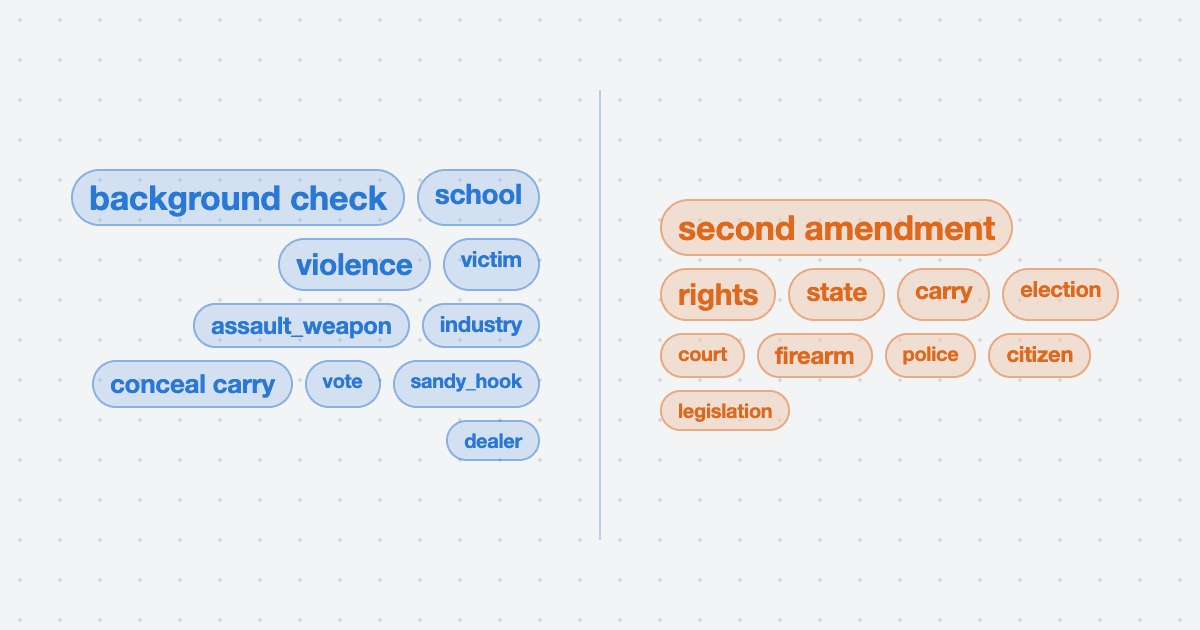
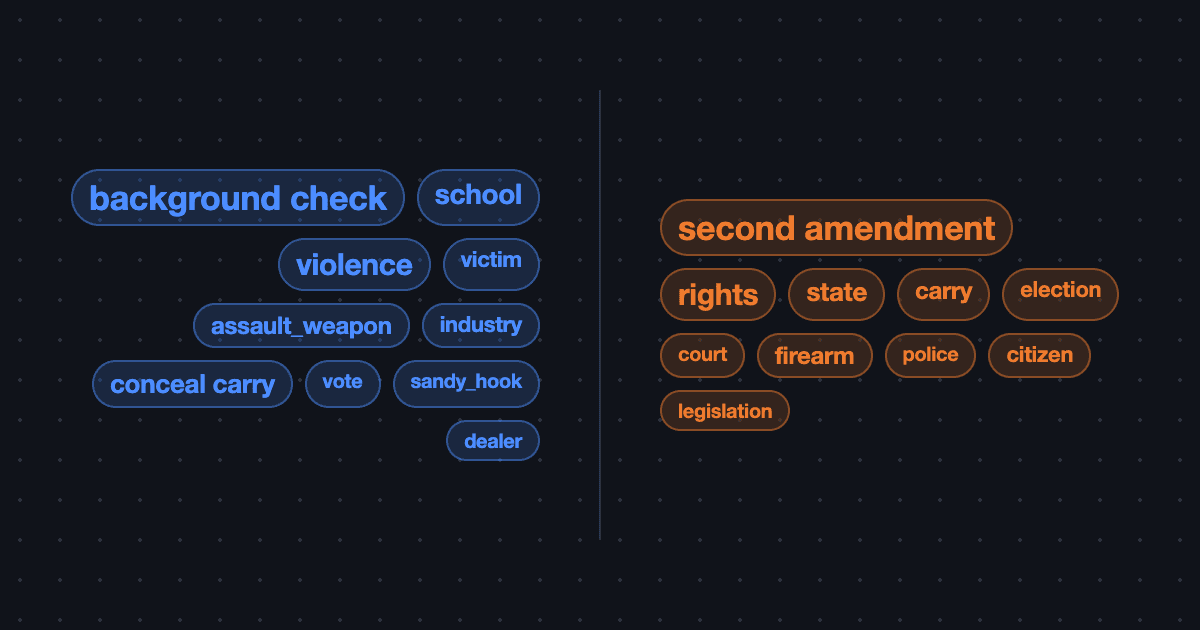
I trained a topic model for each movement and tried 2 to 20 topics. Six is where the gains level off.
Redrawn from the thesis's Figures 2 and 3; values read off the plots.
Each topic is a cluster of words that tend to show up together. I read the statements behind each one and named the frame. Tap a frame for a real quote.
Gun control
Everytown, Brady, Giffords, Coalition to Stop Gun Violence, Sandy Hook Promise, Violence Policy Center
Gun rights
NRA, Gun Owners of America, Second Amendment Foundation
What people engage with
Then I scored every Facebook post from Everytown and the NRA, the largest group on each side, by its mix of frames, and checked which frames predict more or less engagement.
Everytown (gun control)
- Concealed Carry+11%
- Violence & Victims-31%***
- Elections & NRA-14%
- Firearms Industry+21%
- Background Checks+34%**
- School Shootings+6%
NRA (gun rights)
- Elections-15%
- State Laws+105%***
- Firearms-57%**
- Gun Rights+32%*
- Shootings-1%
- Legislation-48%**
A post made entirely of one frame, compared with posts that don't use it, from separate OLS models with controls for images, video, emotion and sentiment. Solid bars are significant (* p<.05, ** p<.01, *** p<.001); outlined bars aren't. Engagement is logged, so the percentages are approximate.
- Everytown: Background Checks earned more likes, and Firearms Industry far more comments and shares. Violence & Victims did worse on all three.
- NRA: State Laws roughly doubled likes and shares, and Gun Rights lifted all three. Firearms, Legislation and Shootings did worse.
The pattern
The frames that worked on both sides did three things at once.
1 · Diagnose
Name a specific problem.
e.g. The gun show loophole
2 · Prescribe
Offer a specific fix.
e.g. Universal background checks
3 · Motivate
Give a reason to act now.
e.g. A vote or protest coming up
Did well
Everytown: Background Checks, Firearms Industry
NRA: State Laws, Gun Rights
Did worse
Diagnosis only: Violence & Victims, Firearms
Contested: the NRA's "good guy with a gun" Shootings posts
The difference is in the foundation. Everytown wins with concrete problems and fixes. The NRA wins by treating the Second Amendment as the thing to defend. Its top State Laws post was a single image: "25 states have enacted NRA Constitutional Carry."
Caveats
- The model reads Facebook posts with the vocabulary it learned from press statements, so new topics on Facebook go unseen.
- A comment or share can be an argument, not support.
- Framing is one piece. Money, organizing and polarization among politicians matter too.
The full thesis, with the methods, tables and references: Prasanna (2023), PDF, 63 pages.